The Rolex “Giraffe” Daytona
126555TBR: Complete Guide
Reference number, off-catalog history, full specs, market pricing, authentication checklist — everything collectors and sellers need to know.
The Rolex “Giraffe” is an off-catalog Cosmograph Daytona (ref. 126555TBR) introduced in 2025. It features an 18k Everose gold 40mm case, a chestnut brown lacquer dial with diamond-pavé patches mimicking giraffe hide, a baguette-cut diamond bezel, and — for the first time ever — a brown Oysterflex strap. It is distributed by invitation only through select Rolex boutiques and had observed Chrono24 asking prices of approximately $253,000–$326,000 as of September 30, 2026. These are advertised prices, not verified sale results or guaranteed seller proceeds.
What Is the Rolex “Giraffe” Daytona?
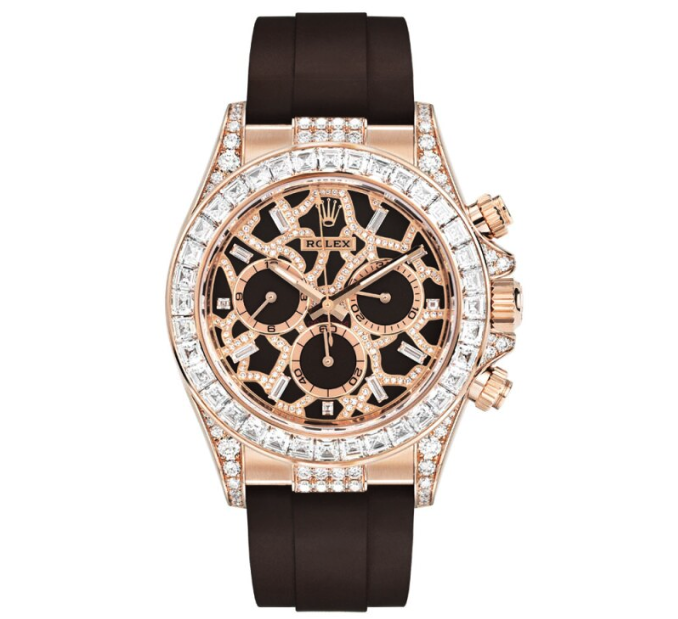
Few watches in the modern era generate as much collector conversation as the Rolex Cosmograph Daytona “Giraffe.” Released in 2025 as a strictly off-catalog special edition, the ref. 126555TBR is Rolex’s boldest high-jewelry Daytona to date — a watch that fuses the brand’s legendary chronograph architecture with exotic dial artistry drawn from the natural world.
The nickname is earned honestly. The dial’s chestnut brown lacquer background is interrupted by irregular diamond-pavé patches — warm amber and champagne stones arranged in a mosaic that genuinely evokes the tortoised hide of a giraffe. It is one of the most instantly recognizable dials Rolex has ever produced, and that visual identity is the engine driving both its cultural cachet and its secondary-market premium.
Unlike the standard Daytona catalog — which collectors can browse on Rolex’s website and purchase through any authorized dealer — the Giraffe sits in Rolex’s invitation-only tier. Rolex does not publish the reference publicly, does not confirm production numbers, and does not advertise a retail price. Access flows entirely through private boutique relationships, and the vast majority of collectors will encounter it only on the secondary market.
The “Giraffe” is not a limited-edition run number. Rolex does not release official production figures for off-catalog pieces. Scarcity is structural — it is determined by how many units Rolex chooses to allocate through its private distribution network, not by a numbered certificate.
What Does “Off-Catalog” Mean for Rolex?
Rolex’s product line divides neatly into two tiers. The catalog tier covers everything on rolex.com — Submariner, Daytona, GMT-Master, Datejust, and their standard variants. These are publicly priced, stocked at authorized dealers worldwide, and manufactured in substantial quantities.
The off-catalog tier is something else entirely. These references are created by Rolex’s in-house gem-setting and dial ateliers, distributed to a small circle of top-tier private clients, and never appear in any official publication. They carry full Rolex authenticity — same movements, same quality standards, same warranty structure — but they operate outside the brand’s normal retail infrastructure.
In the United States, off-catalog access is typically brokered through flagship Rolex boutiques in New York, Los Angeles, and Miami, reserved for clients who have established long-term purchase histories with those locations. For everyone else, the secondary market is the only avenue — and the premium for that access is significant. Off-catalog Daytonas routinely trade at multiples of their (undisclosed) original retail price.
Valuing an off-catalog Rolex requires distinguishing advertised prices from completed sales and dealer offers. The Giraffe listings reviewed on Chrono24 on September 30, 2026 ranged from approximately $253,000 to $326,000, before any additional shipping, taxes, or import charges. This sample is not a valuation of an individual watch. Condition, originality, documentation, and buyer demand affect the offer a seller receives.
The Exotic Daytona Lineage: Leopard → Eye of the Tiger → Giraffe
The “Giraffe” does not exist in isolation. It is the latest chapter in Rolex’s two-decade tradition of producing exotic animal-themed Daytona dials for its most exclusive clientele. Understanding the lineage gives collectors crucial context for why the “Giraffe” commands the prices it does — and why demand is unlikely to soften.
Rolex’s first exotic animal Daytona featured a leopard-print dial executed in a cognac and champagne palette, paired with a matching strap and cognac sapphire bezel. Polarizing at launch, it has since become one of the most coveted off-catalog references of the 2000s. The Leopard established the playbook: full thematic commitment across dial, bezel, and strap, executed in precious materials without compromise.
The “Eye of the Tiger” (Ref. 116598 SACO) raised the stakes dramatically. A tiger-striped diamond-pavé dial, trapeze-cut diamond bezel, and black Oysterflex strap pushed the design into an entirely different register of opulence. The watch gained widespread cultural visibility after appearing on the wrists of DJ Khaled, Conor McGregor, and LeBron James. Secondary market prices have ranged from $180,000 to over $700,000 at auction, depending on provenance.
The Giraffe builds directly on the Eye of the Tiger’s formula while introducing several material firsts: Rolex’s 18k Everose gold (rather than yellow gold), a warm chestnut brown lacquer as the primary dial surface, baguette-cut diamonds alongside cognac-toned stones in the bezel, and — most notably — the first-ever brown Oysterflex strap to appear on any Rolex model. The result is the most tonally unified exotic Daytona yet produced.
The pattern across this lineage is clear: each release introduces a new material innovation or design first, maintaining novelty even within a well-established format. For the “Giraffe,” the brown Oysterflex is that first. Rolex has historically produced Oysterflex only in black; the introduction of brown for this reference signals genuine intentionality rather than cosmetic variation.
Rolex Giraffe 126555TBR — Full Specifications
The table below consolidates all known specifications for the Rolex Cosmograph Daytona “Giraffe.” Where Rolex has not officially confirmed a specification, the values reflect industry consensus from established secondary-market dealers and horological publications.
| Specification | Detail |
|---|---|
| Reference Number | 126555TBR |
| Catalog Status | Off-Catalog / Special Edition (not on rolex.com) |
| Year Introduced | 2025 |
| Case Material | 18k Everose Gold (Rolex proprietary rose gold alloy) |
| Case Diameter | 40mm |
| Case Shape | Oyster (round) |
| Lug Width | 20mm |
| Crystal | Sapphire with anti-reflective treatment |
| Water Resistance | 100 meters (330 feet) |
| Bezel Material | 18k Everose Gold, baguette-cut diamonds + cognac-colored gemstones |
| Dial Color | Chestnut brown lacquer |
| Dial Finish | Lacquer base + diamond-pavé patches in giraffe-spot pattern |
| Subdials | Three chestnut brown lacquer subdials outlined in Everose gold |
| Hour Markers | Diamond-set (brilliant cut) |
| Hands | Everose gold; luminescent coating |
| Strap | Brown Oysterflex (first brown Oysterflex ever produced by Rolex) |
| Clasp | Everose gold Oysterlock folding clasp |
| Movement | Caliber 4131 (self-winding mechanical chronograph) |
| Power Reserve | 72 hours |
| Escapement | Chronergy (patented by Rolex) |
| Shock Absorber | Paraflex |
| Frequency | 28,800 vph (4 Hz) |
| Chronometer Cert. | Superlative Chronometer (COSC + Rolex in-house testing) |
| Retail Distribution | Invitation only — select Rolex boutiques (New York, LA, Miami primary US markets) |
| Observed Asking Prices (Sep. 30, 2026) | Approximately $253,000–$326,000 USD in the reviewed Chrono24 listings; not completed-sale prices |
How the Giraffe Compares to Its Exotic Siblings
The table below places the Giraffe in context against the two most significant predecessors in Rolex’s exotic Daytona series.
| Feature | Leopard (2004) | Eye of the Tiger (2019) | Giraffe (2025) |
|---|---|---|---|
| Case Material | Yellow Gold | Yellow Gold | Everose Gold |
| Dial Pattern | Leopard print (cognac/champagne) | Tiger-stripe diamond pavé | Giraffe-spot diamond pavé on brown lacquer |
| Bezel | Cognac sapphires | Trapeze-cut diamonds | Baguette diamonds + cognac stones |
| Strap | Matching print strap | Black Oysterflex | Brown Oysterflex (first ever) |
| Movement | Cal. 4130 | Cal. 4130 | Cal. 4131 (current gen) |
| Sec. Market Low | $150,000+ | $180,000+ | ~$253,000 asking (Sep. 30, 2026 sample) |
| Design First | First exotic animal Daytona | First Oysterflex exotic | First brown Oysterflex; warmest tonal palette |
Dial & Bezel: What Makes the “Giraffe” Pattern Work
Most gem-set luxury watches fail for the same reason: the jewelry overwhelms the watch. Stones are piled on indiscriminately, the dial loses hierarchy, and the result reads as expensive but incoherent. The Rolex Giraffe avoids this trap with disciplined tonal logic that ties every design element to a single warm-earth palette.
The Dial
The base surface is chestnut brown lacquer — a deep, warm brown with genuine depth that shifts subtly under changing light. Against this ground, Rolex’s gem-setters have arranged irregular patches of brilliant-cut diamond pavé in amber and champagne tones. The stones are not uniformly white; their warm hue is chosen deliberately to mimic the golden-tan spots of giraffe hide rather than the cooler brilliance of traditional white diamond work.
The three chronograph subdials maintain the brown lacquer color but are outlined with thin Everose gold rails that give them structural definition without breaking the dial’s organic visual flow. The result is that even the functional elements — 12-hour counter at 6, running seconds at 9, 30-minute counter at 3 — read as integrated parts of the pattern rather than interruptions of it.
Hour markers are brilliant-cut diamonds set flush into the dial surface. They serve as punctuation: bright enough to catch the eye, small enough not to compete with the pavé field. Readability is preserved — this remains a functional chronograph despite its haute-joaillerie appearance.
The Bezel
The bezel represents the most technically demanding element. Rolex’s gem-setters have mixed baguette-cut diamonds with cognac-colored gemstones — the latter echoing the warm amber tone of the dial’s diamond pavé. Baguette cuts produce a sharper, more architectural light reflection than round brilliants; they create structure rather than scatter. The combination of shapes and stone colors gives the bezel a layered warmth rather than the cold brilliance of an all-white diamond setting.
Rolex sets the bezel stones into an 18k Everose gold frame, which means the metal beneath the stones contributes a warm undertone to the overall appearance. On a white gold or platinum base, the same stones would read colder. The gold substrate is a deliberate material choice, not an afterthought.
Caliber 4131: The Movement Inside the Giraffe
The Giraffe is powered by Rolex’s Caliber 4131, the current-generation self-winding mechanical chronograph movement introduced with the 126500 series Daytona. The 4131 is an evolution of the acclaimed 4130, sharing its column-wheel and vertical clutch architecture while incorporating refinements that extend performance and durability.
| Movement Spec | Caliber 4131 |
|---|---|
| Type | Self-winding mechanical chronograph |
| Winding System | Perpetual rotor |
| Chronograph Mechanism | Column wheel + vertical clutch |
| Escapement | Chronergy (Rolex patented; 15% more efficient than conventional lever) |
| Oscillator | Parachrom hairspring (anti-magnetic, 10× more shock resistant than steel) |
| Shock Absorber | Paraflex |
| Beat Rate | 28,800 vph (4 Hz) |
| Power Reserve | 72 hours |
| Certification | Superlative Chronometer: COSC + Rolex in-house test (±2 sec/day) |
The vertical clutch deserves particular attention: it engages the chronograph mechanism without the jerking of the seconds hand visible in lateral-clutch designs. For a watch at this price point, that smoothness is expected — and the 4131 delivers it reliably. The 72-hour power reserve also means the watch survives a long weekend without winding, which matters practically even on a collector piece this exclusive.
The Brown Oysterflex: A Genuine Rolex First
Of all the design choices on the Giraffe Daytona, the brown Oysterflex strap receives the least attention — and arguably deserves the most. Before the 126555TBR, every Oysterflex strap Rolex had ever produced came in black. Full stop. The material had been paired with yellow gold, white gold, and Everose gold cases; it had appeared on Daytonas, Yacht-Masters, and Sky-Dwellers; it was always black.
The Oysterflex itself is an engineering achievement. Rolex designed it to combine the flexibility and comfort of high-performance elastomer with the structural integrity of an internal metal blade. The blade is a flat titanium-nickel alloy strip embedded within the rubber body; it keeps the strap flat and prevents the twisting or folding that plagues conventional rubber straps. The result wears more like a bracelet than a strap.
The brown colorway on the Giraffe is not simply a tinted black Oysterflex. The coloring is developed specifically for this reference as part of its unified design narrative. Without it, the watch would be a gem-set Daytona with a creative dial. With it, the “Giraffe” is a fully resolved design statement — every element, from dial to clasp, pulling in the same tonal direction.
Because the brown Oysterflex is unique to this reference, any Giraffe Daytona offered without its original brown strap warrants immediate scrutiny. A black Oysterflex substitution may indicate the original strap was damaged, lost, or — in a worst case — that the watch itself is not genuine. Always request the original strap and verify continuity of paperwork before purchase.
Rolex Giraffe Asking Prices & Resale Value (2026)
The figures below are a dated snapshot of Chrono24 listings for reference 126555TBR, reviewed September 30, 2026. Displayed asking prices in the reviewed sample ranged from $253,238 to $325,888, rounded below. Listings can change, and some are price-on-request. These figures do not establish an official Rolex retail price, an auction record, or completed-sale values.
Rounded from $253,238 in the reviewed September 30, 2026 listings. Not a market floor or a guaranteed purchase price.
Rounded range of displayed prices in the reviewed sample. Condition and documentation vary; listing prices are not completed sales.
A dealer offer reflects inspection, originality, completeness, and current demand. Asking prices do not guarantee what an owner will receive.
What Drives the Premium?
Three forces sustain the Giraffe’s secondary-market premium, and understanding them is essential for anyone buying or selling one:
- Structural scarcity. Off-catalog Rolexes are not produced in fixed limited editions. Rolex simply makes fewer of them, allocates them narrowly, and does not restock. Once the initial distribution is absorbed, supply is effectively fixed.
- Recognizability. The “Giraffe” nickname is immediately legible to anyone with even casual watch knowledge. Named watches command premiums over anonymous references because their story is easy to tell — and easy to sell.
- Lineage appreciation. The Leopard and Eye of the Tiger both appreciated materially after their initial distribution. Collectors purchasing the Giraffe are, in part, pricing in the expectation that the same pattern will repeat.
Condition, completeness, and paperwork continuity are the three primary value drivers for off-catalog Rolex transactions. A Giraffe with original box, inner and outer packaging, Rolex warranty card, and the original brown Oysterflex will command a meaningful premium over an example missing any of these components. Never discard the box or papers.
Authentication Guide: Verifying a Rolex Giraffe
The Giraffe is a high-value watch requiring careful professional authentication. An advertised price is not evidence of authenticity. The authentication checklist below covers the highest-risk areas for this specific reference.
-
Brown Oysterflex strap is present and original. The brown Oysterflex is unique to this reference. Any substitute strap — including a black Oysterflex — should trigger immediate review. Inspect the internal metal blade for rigidity; counterfeits often use solid rubber that flops rather than holds its shape.
-
Dial pavé stones are consistent in tone and cut. The warm champagne-amber color of the diamond pavé patches is specific and intentional. Counterfeits frequently use colder, whiter stones or inconsistent pavé setting quality. Under magnification, stones should be precisely set with no exposed prongs or loose seats.
-
Bezel stone mix is correct. Verify that the bezel includes both baguette-cut diamonds and cognac-toned gemstones. A bezel set only in uniform white diamonds is not correct for this reference.
-
Case material is 18k Everose gold. The Giraffe does not exist in yellow gold or stainless steel. Verify metal stamps inside the lugs — Rolex marks 18k Everose with “750” and an Everose logo stamp.
-
Reference 126555TBR is confirmed on caseback and paperwork. The reference number is engraved on the rehaut (inner bezel ring) and should appear on the Rolex warranty card. Verify these match.
-
Caliber 4131 movement is confirmed by a certified watchmaker. A quick movement inspection can confirm the current-generation column-wheel chronograph architecture. Any non-Rolex movement or an older caliber signals a frankenwatch.
-
Serial number falls within 2025 production range. Rolex serial numbers are sequential and date-verifiable. A number inconsistent with 2025 production is a red flag requiring explanation.
-
Original box, inner packaging, and warranty card are present. Off-catalog Rolexes should come with the same complete packaging as catalog references. Missing paperwork does not prove inauthenticity, but it does remove a verification layer and will reduce resale value.
Visual inspection alone is insufficient for authentication at this price point. Always engage a certified independent watchmaker or luxury watch authentication service before completing any transaction. LeWatchBuyers applies multi-point authentication protocols to every watch we evaluate.
Own a Rolex Giraffe? Get a Free Offer.
LeWatchBuyers is a New York–based luxury watch buying service with nationwide reach. We purchase off-catalog Rolex references — including the Giraffe Daytona, Eye of the Tiger, Rainbow Daytona, and other special editions — at competitive, data-driven prices. No pressure. No lowball offers. Just a direct, fair quote from watch professionals who actually understand what your watch is worth.