The most complete Rolex serial number reference online — a free lookup tool, year charts for every era from 1926 to present, an authentication checklist, and what watches from each serial era are worth.
A Rolex serial number is a unique ID code engraved on every watch made since the 1920s. On watches made before mid-2010, the serial follows a known sequence, which lets you date production to within 1–2 years. From mid-2010 onward, however, Rolex switched to random letter-and-number serials — these cannot date the watch, so original paperwork becomes essential. Once the serial places your watch in an era, the reference number and condition then map that era to a value range, which is covered in the value section below.
Rolex Serial Number Lookup & Check
Enter your serial — numeric, letter-prefix, or modern randomized — for an instant production-era estimate, the correct engraving location for that era, and what to verify next.
Production years are approximate (±1–2 years) and reflect collector-documented batch data — Rolex publishes no official serial list. Full reference on this page: numeric tables · letter prefixes · authentication checklist.
- Serial Number Lookup Tool (Free)
- Where to Find Your Rolex Serial Number
- Rolex Serial Numbers by Year (1926–1987)
- Letter Prefix Table (1987–2010)
- Post-2010 Randomized Serials & Clasp Codes
- Collector Context: Models by Production Era
- How to Check a Serial for Authenticity
- Missing or Altered Serial Numbers
- From Serial Number Lookup to Value
- Frequently Asked Questions
Where to Find Your Rolex Serial Number
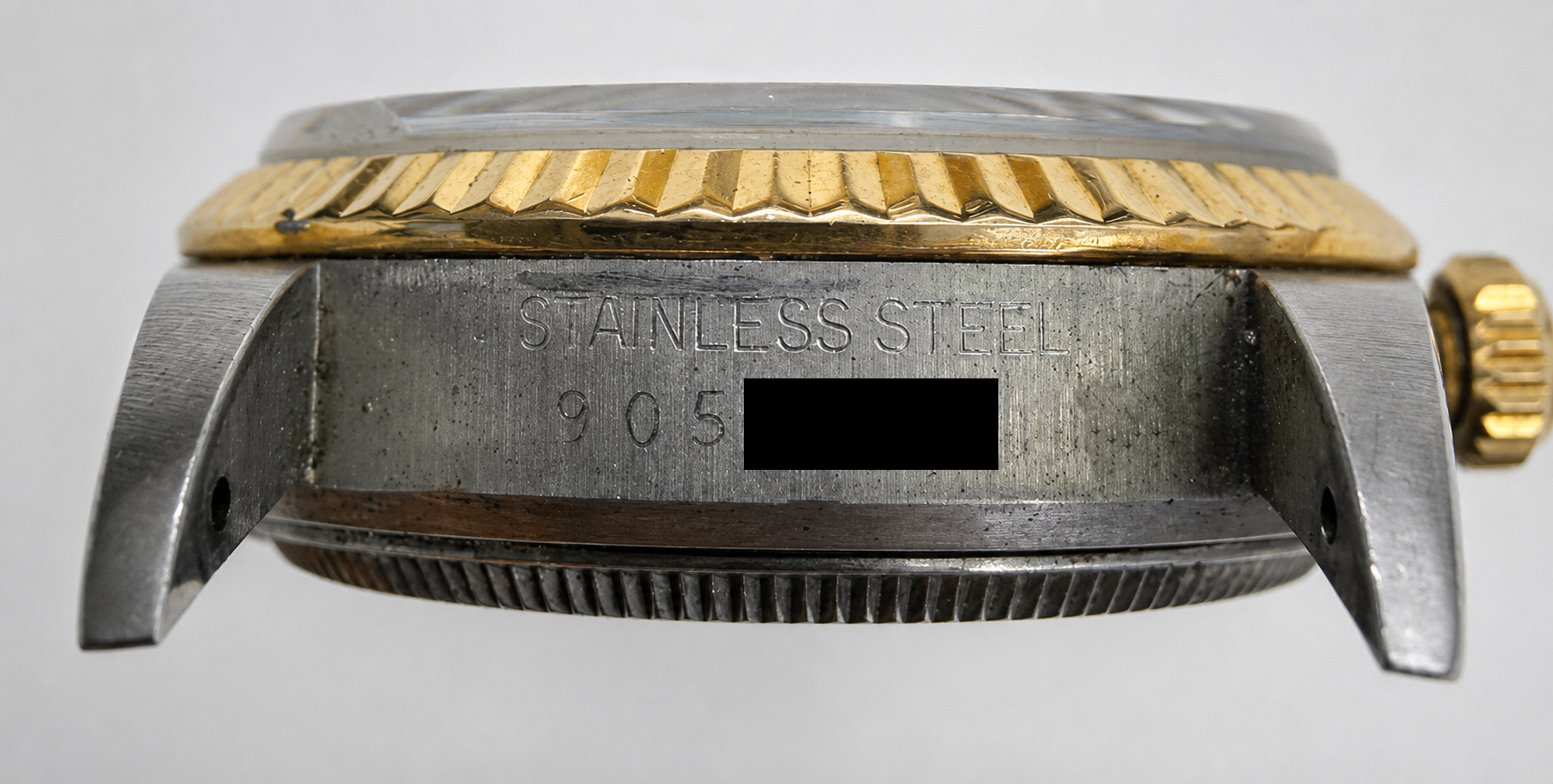
The location of the serial engraving has moved three times over Rolex's history. Because of this, the first step is knowing which era your watch belongs to — that tells you where to look, and whether you need to remove the bracelet at all.
The Three Serial Locations by Era
Between the lugs at 6 o'clock
Engraved on the case side between the lugs. You must remove the bracelet to read it. Fortunately, a spring bar tool or a watchmaker can do this safely in seconds.
Both locations present
Rolex used dual engraving during this transition window. As a result, the serial appears between the lugs and on the rehaut (inner bezel). However, not all watches in this window have both.
Rehaut at 6 o'clock
Laser-etched on the rehaut — the polished inner ring between the dial and the crystal — visible without removing the bracelet. Simply look at the 6 o'clock position from directly above.
Serial Number vs. Model Number Location
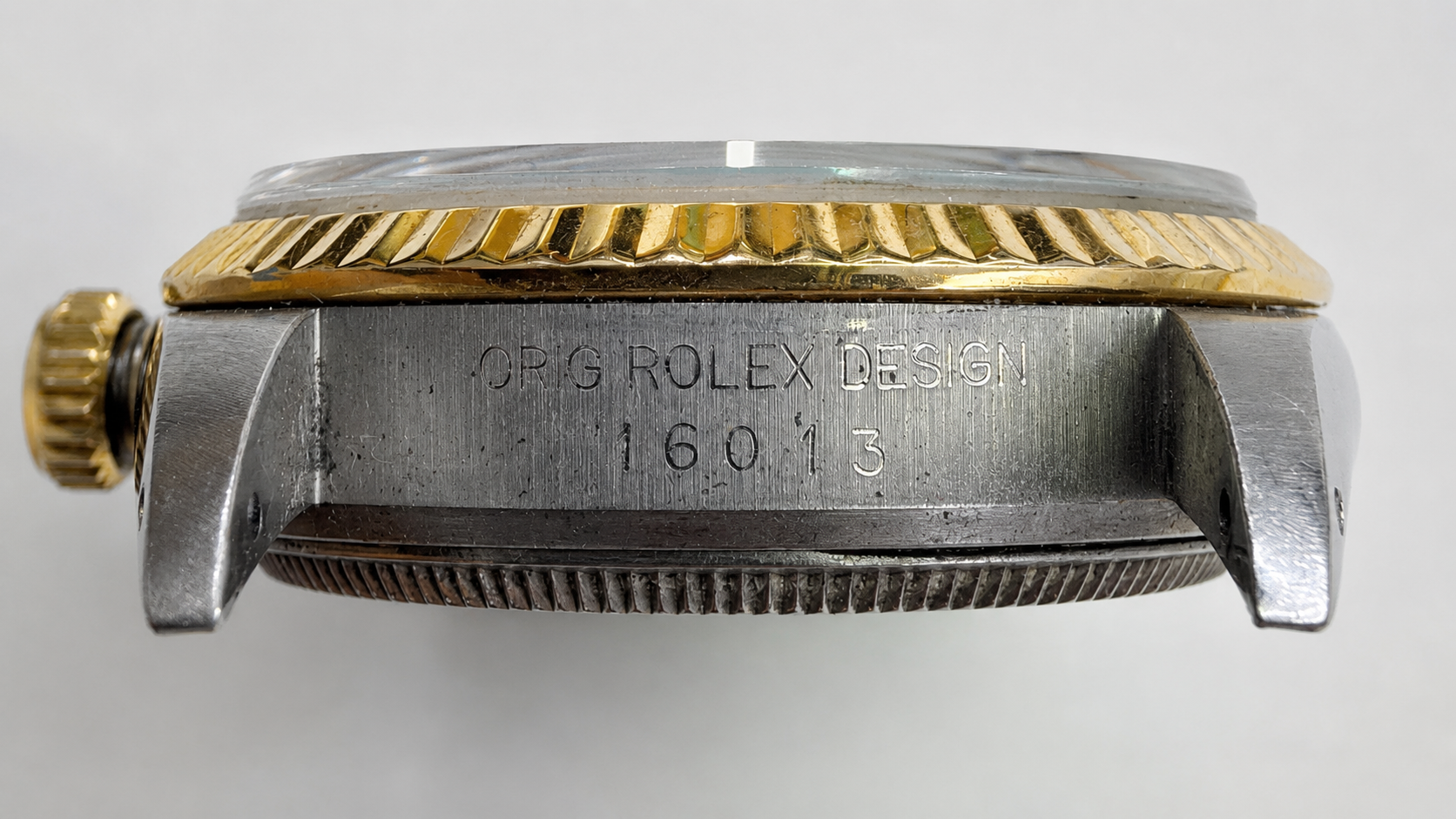
The model (reference) number also sits between the lugs — but at the 12 o'clock position, not the 6. So, whenever you remove the bracelet, check both ends: serial at 6, reference at 12. Then photograph both before you reinstall the bracelet. To decode what each digit of the reference means, see our guide to how to read a Rolex reference number.
Rolex Serial Numbers by Year: Lookup Tables (1926–1987)
From the mid-1920s through 1987, Rolex used numeric serials — but not as one continuous run. In early 1954, the company hit serial 999,999 and, rather than moving to seven digits, restarted the sequence. As a result, a second pass through the six-digit range ran from 1954 to 1963, while seven-digit serials only began around 1964. Dating a numeric serial therefore starts with one question: which sequence is yours?
The 1954 Serial Reset
Six-digit serials between roughly 23,000 and 999,999 exist in two generations: the first sequence (1926–early 1954) and the second (1954–1963). To sort out which era your watch belongs to, first check the reference number's production window. Next, look inside the caseback for quarter-and-year date stamps, which are common on first-sequence watches. Finally, identify the movement caliber. Serials of 1,000,000 and above are clear-cut, since they always date from 1964 onward — and our lookup tool above resolves both eras automatically.
All years below are rough production years, not shipping or retail dates. Rolex built watches in large batches that could reach retailers up to two years later, so treat every range as ±1–2 years and cross-check the model's documented production window whenever you can.
First Sequence: ca. 1926 – Early 1954
| Serial Number Range | Approx. Production Years | Notable Context |
|---|---|---|
| 1 – 20,000 | ca. early–mid 1920s | Pre-Oyster era wristwatches; surviving records are sparse |
| 20,000 – 29,000 | ca. 1926–1931 | First Oyster case introduced (1926) |
| 29,000 – 37,000 | ca. 1932–1936 | Perpetual self-winding movement debuts (1931) |
| 37,000 – 44,000 | ca. 1937–1938 | Pre-war production |
| 44,000 – 71,000 | ca. 1938–1939 | Output accelerates sharply |
| 71,000 – 100,000 | ca. 1939–1940 | Early wartime era |
| 100,000 – 143,000 | ca. 1941–1942 | Wartime production |
| 143,000 – 230,000 | ca. 1942–1943 | Wartime production |
| 230,000 – 302,000 | ca. 1943–1945 | Late-war output |
| 302,000 – 368,000 | ca. 1945–1946 | Datejust introduced (1945) |
| 368,000 – 529,000 | ca. 1946–1947 | Post-war expansion |
| 529,000 – 629,000 | ca. 1947–1948 | Post-war expansion |
| 629,000 – 709,000 | ca. 1949–1951 | Records are sparse for 1949–1950 |
| 709,000 – 855,000 | ca. 1951–1953 | Explorer and Submariner debut (1953) |
| 855,000 – 999,999 | ca. 1953–early 1954 | Final first-sequence serials before the reset |
Second Sequence: 1954 – 1963 (After the Reset)
| Serial Number Range | Approx. Production Years | Notable Context |
|---|---|---|
| 23,000 – 97,000 | ca. 1954–1955 | The serial reset begins; GMT-Master 6542 follows (1955) |
| 97,000 – 133,000 | ca. 1955–1956 | Day-Date debuts (1956) |
| 133,000 – 224,000 | ca. 1956–1957 | Milgauss 6541 era |
| 224,000 – 328,000 | ca. 1957–1958 | — |
| 328,000 – 399,000 | ca. 1958–1959 | — |
| 399,000 – 516,000 | ca. 1959–1960 | Submariner 5512 introduced (1959) |
| 516,000 – 643,000 | ca. 1960–1961 | — |
| 643,000 – 744,000 | ca. 1961–1962 | Submariner 5513 introduced (1962) |
| 744,000 – 824,000 | ca. 1962–1963 | Cosmograph Daytona 6239 debuts (1963) |
| 824,000 – 999,999 | ca. 1963–early 1964 | Final second-sequence serials; seven digits follow |
Seven-Digit Serials: 1964 – 1987
| Serial Number Range | Approx. Production Years | Notable Context |
|---|---|---|
| 1,000,000 – 1,100,000 | ca. 1963–1964 | Seven-digit serials begin |
| 1,100,000 – 1,200,000 | ca. 1965 | — |
| 1,200,000 – 1,538,000 | ca. 1966 | — |
| 1,538,000 – 1,752,000 | ca. 1967 | Sea-Dweller 1665 introduced (1967) |
| 1,752,000 – 1,900,000 | ca. 1968 | — |
| 1,900,000 – 2,240,000 | ca. 1969 | — |
| 2,240,000 – 2,590,000 | ca. 1970 | — |
| 2,590,000 – 2,890,000 | ca. 1971 | Explorer II 1655 introduced (1971) |
| 2,890,000 – 3,200,000 | ca. 1972 | — |
| 3,200,000 – 3,567,000 | ca. 1973 | — |
| 3,567,000 – 3,862,000 | ca. 1974 | — |
| 3,862,000 – 4,115,000 | ca. 1975 | — |
| 4,115,000 – 5,000,000 | ca. 1976 | An unusually wide production batch |
| 5,000,000 – 5,737,000 | ca. 1977–1978 | — |
| 5,737,000 – 6,434,000 | ca. 1979 | — |
| 6,434,000 – 6,521,000 | ca. 1980 | — |
| 6,521,000 – 7,100,000 | ca. 1981 | Sapphire-crystal Submariner 16800 era |
| 7,100,000 – 7,400,000 | ca. 1982 | — |
| 7,400,000 – 8,070,000 | ca. 1983 | GMT-Master II 16760 introduced (1983) |
| 8,070,000 – 8,614,000 | ca. 1984 | — |
| 8,614,000 – 8,900,000 | ca. 1985 | — |
| 8,900,000 – 9,400,000 | ca. 1986 | — |
| 9,400,000 – 9,999,999 | ca. 1987 | Final numeric serials; the R prefix begins mid-1987 |
Letter Prefix Serial Table (1987–2010)
In 1987, Rolex ran out of numeric serials and switched to a letter-prefix system instead. Each letter marks a production batch that began in a specific year, and the letter precedes a six-digit number (for example: R123456).
Overlap warning: several prefixes span more than one calendar year, because Rolex opened new batches mid-year rather than on January 1st. In other words, the dates below show when each prefix batch began — the same prefix can appear on watches delivered up to two years later.
| Prefix Letter | Approx. Year Initiated | Notable Production in This Period |
|---|---|---|
| R | 1987 | First letter-prefix batch; Daytona ref. 16520 debuts (1988) |
| L | 1988 | GMT-Master II ref. 16710 introduced |
| E | 1990 | Submariner ref. 16610 dominant |
| X | 1991 | — |
| N | 1991 (late) | Daytona ref. 16520 in full production |
| C | 1992 | — |
| S | 1993 | — |
| W | 1995 | Sea-Dweller ref. 16600 era |
| T | 1996 | — |
| U | 1997 | Final-era 16520 Daytona production |
| A | 1998 | GMT-Master II ref. 16710 "Coke" and "Pepsi" bezel production |
| P | 2000 | Daytona 116520 debuts (2000); Submariner 16610LV "Kermit" follows (2003) |
| K | 2001 | — |
| Y | 2002 | — |
| F | 2003 | — |
| D | 2005 | Rehaut engraving introduced; dual-location transitional period begins |
| Z | 2006 | GMT-Master II ref. 116710 (Cerachrom bezel) introduced |
| M | 2007 | — |
| V | 2008–2009 | Rehaut-only engraving becomes standard |
| G | 2010 | Final sequential prefix before randomization (mid-2010) |
Post-2010 Randomized Serials
In mid-2010, Rolex changed its serial system from the ground up. Since then, every serial is a random string of letters and numbers with no built-in date order. Consequently, a watch made in 2022 may carry a serial that looks "older" than one made in 2015.
What This Means for Buyers and Sellers
- First, you cannot date a post-2010 Rolex by serial alone. The serial verifies uniqueness and authenticity — not the production year.
- Because of that, original paperwork is now critical. Warranty cards and service records are the primary proof of age on modern pieces.
- Meanwhile, Rolex's anti-counterfeiting goal was met. Random serials mean fakes can no longer copy known production timelines.
- Even so, the serial still confirms authenticity. A genuine engraving carries physical traits that fakes fail to copy — random or not.
Clasp Codes: A Backup Dating Clue
One more dating clue survives on the bracelet: the clasp code, stamped inside the clasp. From the mid-1970s through the early 2000s, this code pairs a letter for the year with a number for the month — for instance, a clasp stamped G4 points to April 1982. Two cautions apply, however. First, the code dates the bracelet, not the watch head, and bracelets are often swapped or replaced during service. Second, Rolex phased out meaningful clasp coding around the time randomization began, so a modern clasp won't tell you much. Even so, on a watch with no papers, a period-correct clasp code is one more consistency check worth running.
If you're selling a post-2010 Rolex, first gather every document you have: the original warranty card (green for older pieces, white for modern), any service invoices, the box, and the hang tag. These papers directly support your asking price. In fact, a modern Rolex with its full set usually brings 10–20% more than a watch-only example.
Collector Context: Models by Production Era
Serial numbers gain meaning once you cross-check them against known reference production windows. For example, a serial that predates a model's launch is an instant red flag. Below, then, is a quick guide to the most-traded references and when each was built.
Production Windows at a Glance
| Model | Reference | Production Era | Serial Prefix / Range |
|---|---|---|---|
| Submariner (no date) | 6204 / 6538 | 1953–1959 | 1st seq. ≈855K–999K → 2nd seq. ≈23K–450K |
| GMT-Master | 6542 | 1955–1959 | 2nd seq. ≈100K–450K |
| Daytona (manual) | 6239 / 6241 / 6262 / 6264 | 1963–1987 | 2nd seq. ≈900K → 7-digit → R prefix |
| Sea-Dweller | 1665 | 1967–1983 | ca. 1.6M – 7.4M |
| Explorer II | 1655 | 1971–1985 | ca. 2.6M – 8.6M |
| GMT-Master II | 16710 | 1989–2007 | L → M prefix |
| Daytona (auto, steel) | 16520 | 1988–2000 | R → P prefix |
| Submariner Date | 16610 | 1988–2010 | L → G prefix |
| Daytona (modern) | 116520 / 116500LN | 2000–present | P prefix → randomized |
| GMT-Master II "Pepsi" | 126710BLRO | 2018–present | Randomized only |
If a serial places a watch in an era before its reference existed, then the watch is either misidentified or fraudulent. For instance, a watch presented as a ref. 16520 Daytona with a serial near 2.0M (ca. 1969) is impossible — that reference didn't enter production until 1988.
How to Check a Rolex Serial Number for Authenticity
Checking the serial is one part of authenticating a Rolex — not the whole picture. Here, then, is the eight-point protocol our appraisal team runs before we buy any watch. The first group examines the engraving itself, while the second confirms that everything on the watch tells the same story.
Engraving Checks (Points 1–3)
- Engraving depth and crispness. Genuine Rolex engravings are deep-cut with clean, even edges. Fakes, by contrast, tend to look shallow, slightly blurry, or unevenly spaced — above all under a 10x loupe.
- No signs of re-engraving. Look closely at the metal around the digits, because re-cut serials often show tool marks, uneven depth, or disturbed texture.
- Rehaut crown alignment. On post-2008 watches, the etched crown logo should line up exactly with the 12 o'clock marker. If it sits off-center, then the dial or rehaut is not genuine.
Consistency Checks (Points 4–8)
- Serial location matches the era. Pre-2005 serials belong between the lugs, whereas post-2008 serials belong on the rehaut. So a 2014 Submariner with a lug-only engraving is a serious red flag.
- Serial era fits the reference window. Cross-check the serial year against the model's known production dates, because any mismatch points to a case swap, a frankenwatch, or a fake.
- Movement caliber matches the era. Ask for a caseback inspection, since the caliber engraved on the movement bridge should match what Rolex used for that reference in that year.
- No duplicate serials. Genuine serials are unique. Therefore, if a second watch surfaces with the same number, one of the two has been faked or rebuilt.
- Papers match the metal. If the watch comes with papers, the serial on the warranty card must match the engraving exactly — including the letter prefix on pre-2010 watches.
"The engraving is where fakes give themselves away first. A real Rolex serial is cut deep, spaced evenly, and catches light the same way across every character. The moment one digit sits shallower than its neighbors, I stop and reach for the loupe — nine times out of ten, that watch has a problem."
— Xenon · Watch Appraiser & Expert, Le Watch Buyers
Why Online Checkers Aren't Enough
Don't rely on online serial checkers alone. Free tools can confirm a serial is structurally plausible; however, they cannot tell you whether that serial sits on a fake case, whether parts have been mixed, or whether papers were forged. In the end, a hands-on inspection by an experienced buyer or watchmaker is something no website can replace.
Missing or Altered Serial Numbers
A missing or faded serial is not always a sign of fraud — but it always calls for a closer look before money changes hands.
Common Legitimate Causes
- Over-polishing. Aggressive polishing by a past owner or a careless service shop can thin or erase lug engravings. In fact, this is common on watches that have passed through many hands.
- Age and wear. On watches 40–60+ years old, decades of daily wear can slowly grind down shallow vintage engravings.
- Factory service. In rare cases, Rolex has replaced cases during service — which means the serial on the new case may differ from the original papers.
Red Flags That Suggest Tampering
- The serial looks partly ground down, yet not fully removed
- The serial appears re-cut, with an odd font or uneven depth
- The lug area shows tool marks that normal wear can't explain
- Above all, the watch comes with no paperwork to support its story
We review watches with worn or doubtful serials through a mix of movement inspection, case assessment, dial provenance, and market comps. In other words, a missing serial doesn't disqualify a watch by itself — it simply adds steps before we make an offer. Moreover, we're upfront about that process from the first call.
From Serial Number Lookup to Value: What Your Rolex Is Worth
A serial lookup gives you the production era — not a price. No database maps Rolex serials to dollar values, and any site claiming otherwise is guessing. What the serial does, however, is supply the first of three inputs that together set the price: the era shows which generation you own, the reference sets the value tier, and condition plus completeness decide where inside that tier your watch lands.
The Serial-to-Value Chain
The lookup gives you the era. First, use the tool above to place your watch in a production window and to flag era mismatches that would signal a swapped case or a fake.
The reference sets the tier. Next, the model number at 12 o'clock defines the value band — two watches from the same era can sit $10,000+ apart on reference alone.
Condition lands the number. Finally, originality, polish history, and matching paperwork decide where in the band your watch falls — a full set adds 10–20%.
We call this the serial-to-value chain, and it's how our team prices every Rolex we review. The lookup above handles step one, while the table below handles step two, showing what watches from each serial generation typically bring today.
Typical Value Ranges by Serial Era
| Serial Era | Years | What These Watches Typically Bring* |
|---|---|---|
| First sequence (numeric) | ca. 1926–1954 | Most dress references trade at $1,500–$8,000; rare early sports and oversized chronograph references reach five and six figures |
| Second sequence (numeric) | ca. 1954–1963 | Dress models $2,000–$6,000; first-generation sports pieces (GMT-Master 6542, big-crown Submariners) trade from $25,000 into six figures |
| Seven-digit (numeric) | ca. 1964–1987 | Datejust 1601 $3,000–$6,500 · Submariner 5513 $12,000–$25,000 · GMT-Master 1675 $10,000–$20,000 · manual-wind Daytonas from $40,000, with Paul Newman dials reaching six and seven figures |
| Letter prefix | 1987–2010 | Datejust 16234 $4,000–$6,500 · Submariner 16610 $7,500–$10,000 · GMT-Master II 16710 $10,000–$16,000 · Daytona 16520 $22,000–$45,000 |
| Randomized | mid-2010–present | Oyster Perpetual 41 $6,000–$7,500 · Submariner 126610LN $11,500–$14,000 · GMT-Master II "Pepsi" $16,000–$20,000 · Daytona 116500LN $23,000–$28,000 |
*Typical U.S. secondary-market ranges as of July 2026 — benchmarked against open-marketplace listings and analytics data (Chrono24, WatchCharts) as well as our own purchase records — for complete examples in honest condition. Condition, originality, dial variant, and box/papers move every number, in both directions. Entry-level references sit at the bottom of each era's band.
An older serial doesn't automatically mean a more valuable Rolex. For example, a 1968 Datejust 1601 and a 1968 Submariner 5513 come from the same serial era, yet the Submariner trades for roughly three to four times as much. Reference outranks age — the serial's job, rather, is to confirm the era and prove the watch is what the seller says it is.
What Moves an Offer Up
- Serial matches the warranty card exactly — above all, this is the strongest trust signal in any sale
- Full set (box, papers, booklets, hang tag) — as noted, it adds 10–20% to offers on modern pieces
- Unpolished case with crisp lug lines as well as an original, unrestored dial
- Documented service history, such as Rolex service cards or retailer receipts
- Era-correct parts throughout — bezel insert, bracelet, clasp, and movement all consistent with the serial's window
What Kills an Offer
- Worn or partial serial — still sellable, yet buyer doubt prices in a discount
- Serial that doesn't match the paperwork — because papers only add value when the numbers agree
- Re-engraved or altered serial — near-zero resale through honest channels, regardless of the watch's other merits
- Aftermarket parts or refinished dials — collectors pay for originality rather than restoration
- Heavy over-polishing that rounds off the case lines collectors check first
Serial Numbers and Insurance
The serial matters beyond resale, too. Most high-value watch policies require a matching serial on the appraisal you submit for coverage; without one, insurers may decline the application or cut the insured value. Likewise, after a theft, police and insurers treat the serial as the primary recovery ID — so a watch without one is far harder to recover and claim on. For that reason, photograph your serial today and store it with your purchase records.
Skip the Range. Get Your Exact Number.
The table above tells you the neighborhood — an appraisal tells you the address. So send photos and your serial, and our team will price your specific watch against live market data: free, no-obligation, usually same day.
Get a Free Rolex Valuation →Frequently Asked Questions
Can two Rolex watches have the same serial number?
No. Rolex serial numbers are unique production IDs — no two genuine watches share the same serial. Therefore, if two watches surface with matching serials, one has almost certainly been faked, or one has had its case, movement, or engraving altered. In fact, this is one of the most reliable authenticity tests available.
How accurately can I date a Rolex using its serial number?
For pre-2010 watches, to within 1–2 years in most cases. The uncertainty exists because Rolex built watches in large batches that sometimes sat in inventory before shipping. In other words, the serial tells you when the watch was made, not when it was sold. Post-2010 watches, however, cannot be dated by serial at all — the random system carries no date information.
What does a post-2010 Rolex serial number look like?
Modern random serials are eight-character strings that mix letters and numbers in no set order (for example: 3D8F2K1J or 7T1W4A9B). Unlike 1987–2010 serials, they do not begin with a single meaningful letter prefix. If you're unsure whether a serial is pre- or post-randomization, then a quick look at our letter-prefix table above will settle the era.
How do counterfeit watches fake serial numbers?
The most common method is shallow engraving on an otherwise cast or stamped case. As a result, fake serials often look slightly blurry, unevenly spaced, or shallower than the surrounding metal. Under a loupe, you'll also see rough edges and uneven depth that genuine Rolex machine engraving never shows. High-end fakes may try acid etching, but even these fail under expert inspection. Placement is the other tell: for instance, a modern Rolex serial on the case lugs rather than the rehaut is instantly suspect.
My serial number isn't in your table. What does that mean?
A serial that falls between the boundaries in our tables simply means the watch was made in the transition between those two ranges — so read it as sitting between the two years. If a serial looks structurally wrong, however (the wrong digit count, an odd character mix for the era, or an unknown prefix letter), it may point to tampering, a non-Rolex watch, or a special-market piece with different numbering. In that case, bring it to a pro for review.
Do free Rolex serial number checkers online actually work?
They're useful for confirming that a serial fits Rolex's known format — but they have real limits. For example, they cannot confirm the serial belongs to the watch in front of you, catch well-made fakes with correctly formatted serials, or tell you whether the movement was swapped. Use them as a first filter, therefore, not a final verdict. Hands-on review by a qualified buyer or watchmaker remains the only reliable method.
Can Rolex restore a missing serial number?
No. Rolex does not re-engrave lost or damaged serials through its service program. Furthermore, having a serial re-cut by a third party would not be verifiable and would likely read as tampering to informed buyers, insurers, and auction houses. If the serial is gone, then the watch must be priced on its other verifiable traits: movement authenticity, dial provenance, case condition, and paperwork.
Can I look up my Rolex's value by serial number?
Not directly — no database maps Rolex serials to prices, because the serial itself carries no value information. Instead, a serial lookup gives you the production era, which is the first step in valuing the watch: combine the era with the reference number and the watch's condition, and you land in a defined market range. The value table above shows typical ranges for each era, while a free appraisal turns that range into an exact offer.
Does the serial number affect how much my Rolex is worth?
Yes, and by a lot. A clear, matching serial with original paperwork is the benchmark for top value. Each step away from that benchmark — a worn serial, a missing serial, a mismatched serial — cuts buyer confidence and offer prices. For vintage references above all, the serial is often the only way to confirm the era, which feeds directly into collector value. Before selling, therefore, understand where your watch sits on this spectrum so you can set fair expectations.
Does an older serial number mean a more valuable Rolex?
Not by itself. The reference outweighs age in nearly every case: for example, a 1968 Datejust 1601 typically trades around $3,000–$6,500, while a Submariner 5513 from the same era brings $12,000–$25,000. Age adds value mainly when it's paired with a desirable reference, original parts, and supporting papers — otherwise, an old serial on a common reference in rough shape is simply an old watch.
Ready to Find Out What Your Rolex Is Worth?
Our appraisal team verifies serial numbers, cross-checks production data, and provides transparent, no-obligation offers — typically within 24 hours.
Get Your Free Rolex Evaluation →