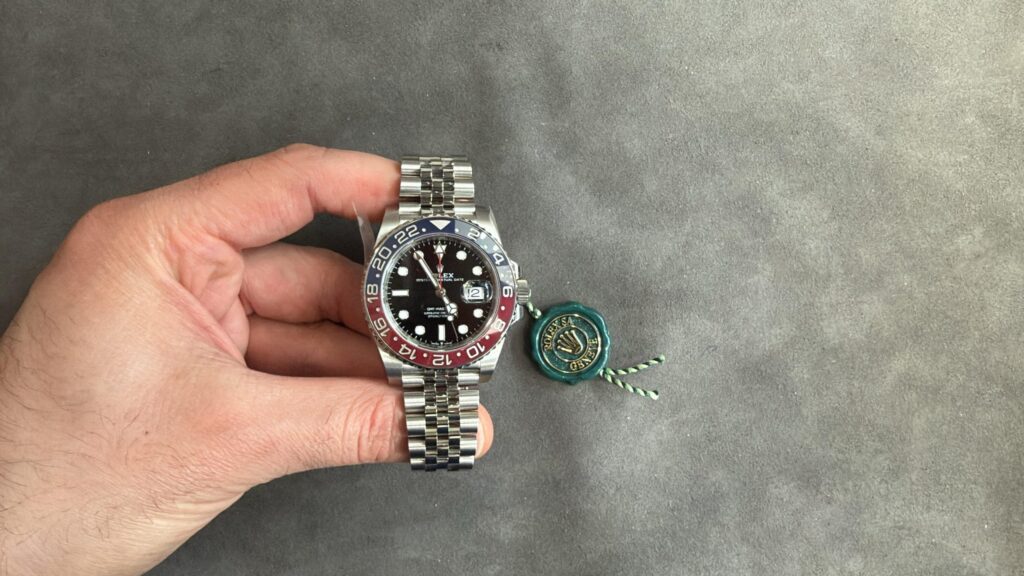
Watches & Wonders 2026, Geneva — April 14, 2026. Rolex confirms the end of the Pepsi GMT.
The Rolex Pepsi Is Officially Discontinued. Here’s Everything That Matters.
Seventy years of red and blue. One product page returning a dead end. What happened, the complete history, the Coke patent story, and what your watch is worth right now.
At Watches & Wonders 2026 in Geneva, Rolex confirmed the discontinuation of the GMT-Master II “Pepsi” by removing it from its official configurator and product catalogue. The steel ref. 126710BLRO and white gold ref. 126719BLRO are both gone, along with the white gold “Cookie Monster” Submariner Date (ref. 126619LB). The 126710BLRO product page on rolex.com now returns a dead end. For the first time since the ceramic bezel era began, Rolex’s steel GMT-Master II lineup contains no red bezel whatsoever. No ceramic Coke GMT was announced in its place. Prices on the secondary market moved immediately.
- What Happened at W&W 2026
- 70 Years of the Pepsi: Full Reference History
- The Ceramic Bezel Challenge
- The Coke Patent — and the Unanswered Question
- What’s Left: The 2026 GMT Lineup
- Cookie Monster: The Other Discontinuation
- Secondary Market: What Prices Did After the News
- The Hulk Comparison — and Why It’s Imperfect
- Selling Your Pepsi? Read This First
- FAQ
What Happened at Watches & Wonders 2026
The watch industry had been bracing for this for months. Since late 2025, the Rolex GMT-Master II Pepsi had been quietly vanishing from Authorized Dealer websites across the United States and Europe. By February 2026, WatchPro confirmed what dealers had been told privately: no further deliveries of the ref. 126710BLRO were coming. Waiting lists were being redirected. The watch’s absence from the configurators at Bucherer, Lux Bond & Green, and dozens of other ADs was no longer ambiguous — it was a de facto announcement.
What nobody knew was the shape of the official confirmation. The annual Rolex catalogue refresh at Watches & Wonders Geneva is the moment the brand communicates through its products rather than its words. On April 14, 2026, the format was identical to how Rolex always handles discontinuations: the product page for the 126710BLRO was replaced with a dead end, the GMT-Master II configurator was updated to show three remaining steel bezel options, and no statement was issued. The watch was simply gone.
Navigate to the GMT-Master II section on rolex.com right now and you will find black and grey (“Bruce Wayne”), blue and black (“Batman” on Oyster or “Batgirl” on Jubilee), and green and black (“Sprite”). There is no red. There is no blue and red. For the first time in the ceramic era of the GMT-Master II, the bezel that defined the collection for seventy years is not available.
Ref. 126710BLRO (Oystersteel Pepsi, Jubilee & Oyster bracelet) · Ref. 126719BLRO (White Gold Pepsi) · Ref. 126619LB (White Gold “Cookie Monster” Submariner Date). All three vanished from the official Rolex configurator during the April 14 product refresh. No replacement for the Pepsi colorway was announced.
Seventy Years of the Pepsi: The Complete Reference History
The red and blue bezel did not begin as an aesthetic choice. It began as a functional solution to a professional problem. In 1954, Pan American World Airways commissioned Rolex to create a watch capable of displaying two time zones simultaneously for their long-haul pilots navigating transatlantic routes. The result debuted in 1955. A red half of the 24-hour bezel represented daylight hours; a blue half represented night. The combination was a legibility tool before it was ever a collector icon.
Seventy years later, the visual language is so deeply embedded in watch culture that the Pepsi nickname is essentially inseparable from the watch itself. Here is the complete production history:
The Ceramic Bezel Challenge: Why the Two-Colour Insert Is Difficult
The 11-year gap between the last aluminium Pepsi (ref. 16710, discontinued 2007) and the first ceramic Pepsi (ref. 126710BLRO, 2018) is not simply explained by brand strategy. There is a genuine manufacturing challenge at the centre of the story.
Rolex’s Cerachrom ceramic bezel material is produced through a sintering process — ceramic powder is compressed and fired at extremely high temperatures. The challenge with a two-colour ceramic insert is achieving a clean, stable transition between colours at the boundary line. Both sections must be sintered together without the colours bleeding into each other. Early attempts at a red and blue ceramic insert reportedly produced exactly this bleeding effect — a fuzzy, unstable boundary rather than the crisp colour division of the aluminium insert.
The Batman (black and blue, ref. 116710BLNR, introduced 2013) arrived five years before the steel Pepsi, partly because achieving a clean ceramic transition between black and blue is technically easier than red and blue. Black ceramic absorbs rather than refracts light, making boundary imperfections less visible. Red ceramic is significantly harder to produce with stability and requires different precursor materials.
The same manufacturing challenge that delayed the Pepsi’s ceramic debut by 11 years is likely still the primary obstacle to a ceramic Coke (red and black) GMT. Red remains the most difficult colour in the Cerachrom palette. Whether Rolex has overcome this for a black and red combination — or whether the bleeding issue persists — is central to understanding the timeline for any potential Coke release.
The Coke Patent — and the Unanswered Question
Before April 14, almost every watch publication in the world called a ceramic Coke GMT as the Pepsi’s replacement at Watches & Wonders 2026. The logic was tight. In 2022, Rolex filed US patent 12,428,335 B2. It describes a manufacturing process specifically designed to produce a stable red and black ceramic bezel insert. This is not a general ceramic technology patent. It is, as precisely as a patent can be, a description of how to make a Coke GMT bezel.
The Coke colorway — black case half and red bezel half — debuted on the GMT-Master II in 1982 on the ref. 16760 “Fat Lady,” the first GMT-Master II. It ran through the ref. 16710 until 2007. The Coke has never been produced in ceramic. The 2022 patent pointed directly at that 19-year gap. Combined with the Pepsi’s exit, the logic of a Coke replacement was as close to certain as the watch industry gets about Rolex’s unreleased plans.
Watches & Wonders 2026 did not deliver a Coke. Rolex discontinued the Pepsi, updated the GMT lineup with no red bezel in any configuration, and said nothing. The consensus was wrong. The Coke, if it is coming, is not coming now.
There are two credible theories for why:
The technical obstacle persists. The red-and-black transition in ceramic may still carry bleeding or stability issues that Rolex has not yet resolved to the standard required for release. Holding a patent for a manufacturing process is not the same as completing commercial-grade production at scale. Rolex will not release a product it is not satisfied with — this is the same brand that took 11 years to bring the ceramic Pepsi to steel.
Rolex deliberately held the Coke back. By not releasing it alongside the Pepsi’s exit, Rolex guarantees a major hype event for a future watch fair when the calendar might otherwise be quieter. Nearly every watch publication had the Coke “confirmed” before W&W opened. Rolex proved them all wrong in a single catalogue refresh. That unpredictability is not accidental — it is how the brand maintains its cultural dominance. The moment Rolex becomes entirely predictable, the mystique that drives demand begins to erode.
What’s Left: The 2026 Steel GMT-Master II Lineup
After the April 14 refresh, the GMT-Master II steel catalogue stands as follows. For the first time in decades, no red appears anywhere in the lineup.
“Pepsi”
Red & blue Cerachrom. Refs: 126710BLRO (Oyster & Jubilee), 126719BLRO (WG). Gone April 14, 2026.
“Batman”
Blue & black Cerachrom, Oyster bracelet. Ref. 126710BLNR. The most available steel sports GMT right now.
“Batgirl”
Blue & black Cerachrom, Jubilee bracelet. Ref. 126710BLNR. Jubilee version of the Batman; introduced 2019.
“Bruce Wayne”
Grey & black Cerachrom, Jubilee. Ref. 126710GRNR. Added 2022. Now the newest colour in the steel lineup.
“Sprite”
Green & black Cerachrom, left-hand crown, Jubilee. Ref. 126720VTNR. Introduced 2022. Left-crown only option.
The lineup is all blue and green and black. The absence of red is stark. Whether a ceramic Coke eventually fills that slot remains the defining open question in the GMT-Master II story.
The Other Discontinuation: White Gold “Cookie Monster” Submariner
The Pepsi was not the only casualty of April 14. The Submariner Date ref. 126619LB — the white gold Submariner with the blue Cerachrom bezel, nicknamed “Cookie Monster” for its blue-on-blue colour palette — was also removed from the catalogue at the same product refresh.
The Cookie Monster occupied a specific niche: a Submariner in precious metal with enough visual distinctiveness to separate it from the standard steel lineup, but without the overt glamour of the gold “Smurf” (ref. 116619LB predecessor) or full diamond-set variants. Its white gold case paired with the bright blue ceramic bezel created a watch that appealed to buyers who wanted something unmistakably different from the steel Submariner while avoiding the yellow or Everose gold options.
Unlike the Pepsi, no replacement has been broadly discussed. The Cookie Monster’s exit is a quieter story, but the same fundamental dynamic applies: no new supply, existing inventory becomes the final allocation, and the secondary market will reflect that over time.
The discontinued ref. 126619LB is the white gold blue-bezel Submariner Date. This is distinct from the steel Submariner “Bluesy” (ref. 126613LB), which is a two-tone steel and yellow gold model with a blue bezel. The steel Bluesy remains in the current catalogue. The “Cookie Monster” specifically refers to the all-white-gold variant.
Secondary Market: Prices, the Numbers, and What Happens Next
The secondary market had been pricing in the Pepsi’s discontinuation for months before Rolex made it official. The direction of travel was clear from the data well before April 14.
| Market Moment | Approx. Secondary Market Price | Notes |
|---|---|---|
| 2018 Launch (retail) | ~$9,500 | Original MSRP, ref. 126710BLRO at Baselworld 2018. |
| 2020 Peak (pandemic demand) | ~$22,000–$36,000 | Widest range; auction peaks hit ~$36K. Market-wide luxury surge. |
| 2023 Correction | ~$18,000–$22,000 | Broad market correction across steel sports Rolex. |
| January 2026 | ~$24,000–$26,000 | Before discontinuation rumours hardened into confirmed dealer news. |
| March 2026 (post-WatchPro report) | ~$26,000–$30,000 | Dealer median up ~$3,000 from January. Chrono24 demand surged 500%+. |
| April 14, 2026 (confirmed) | $28,000–$45,000+ | Immediate post-confirmation movement. Unworn full-set examples listing highest. Market still settling. |
| Retail MSRP (final) | ~$11,800 | Last known retail price before January 2026 price increases. Discontinued watch trades at ~2.5–3.5× retail as of today. |
WatchCharts data shows the 126710BLRO was already up 19.2% over the preceding 12 months before the official confirmation — outperforming the Rolex Market Index (+7.1%) and the broader WatchCharts Overall Market Index (+8.5%) by a significant margin. That outperformance accelerated sharply in the weeks following WatchPro’s February report. The watch also holds a WatchCharts liquidity score placing it in the fastest-selling 9% of watches on the secondary market — it was moving in a median of 16 days in March 2026.
Condition is now everything. With no new supply, the condition spectrum of existing inventory becomes the primary differentiator. Unworn examples with stickers intact command the largest premium. Polished cases significantly erode value for this reference — collectors pay for original surface finish. Box and papers matter more than usual on a discontinued reference, both for authentication and provenance. A full-set 126710BLRO commands $2,000–$5,000 more than a watch-only example depending on condition.
The Hulk Comparison — and Why It Only Goes So Far
The default analogy every market analyst reaches for when discussing the Pepsi’s discontinuation is the Submariner “Hulk” — the green-dialed ref. 116610LV, discontinued in 2020. The Hulk entered the discontinued market at roughly $13,000 and climbed steadily as collectors realized the waitlist was permanently closed. It is now consistently trading well above its discontinuation-era prices.
The parallel is real, but it has a limit. The Hulk was replaced — the “Kermit” (ref. 126610LV) arrived with a green ceramic bezel, effectively continuing the green Submariner story in an updated form. Existing Hulk owners gained a discontinued classic; new buyers got an updated model. The market for each settled into its own tier.
The Pepsi has no confirmed replacement. There is no ceramic Coke on the launch stage today. For an unknown period, anyone who wants red and blue on a GMT-Master II has exactly one option: the secondary market for the 126710BLRO. That structural scarcity is more complete than what the Hulk faced in 2020. Whether a Coke eventually arrives — and how the market recalibrates when it does — is the scenario every Pepsi owner should be thinking about.
The secondary market of 2026 is also not the secondary market of 2020–2022. The speculative bubble that drove the Hulk and everything else to extreme premiums has deflated. The Pepsi’s discontinuation will drive prices up, but the magnitude of the move will reflect a market operating at more rational multiples than the peak. Expert opinion is divided on where the ceiling is. Joshua Ganjei of European Watch Company expects immediate upward pressure given the watch’s blend of heritage and wearability. Others are more measured: the market has been through this cycle of rumour and relief with the Pepsi before, and each time prices eventually corrected. The difference this time is that there is nothing to correct to — no new supply is coming.
Selling Your Rolex Pepsi?
Discontinuation confirmed. Prices are moving. If you have a 126710BLRO — with or without box and papers — this is the moment to get a reference-level offer. Same-day response. No obligation.
Get a Free Offer Today →Selling Your Rolex Pepsi: What It’s Worth and What to Know
If you own a 126710BLRO — either the Jubilee or Oyster bracelet variant — April 14 changed your position. Here is what matters most for anyone considering a sale.
Jubilee vs. Oyster: Does Bracelet Matter?
The 2018 Jubilee-bracelet launch was the only configuration for the first three years of the 126710BLRO’s production. The Oyster-bracelet variant arrived in 2021, giving buyers the choice that Rolex had previously withheld. On the secondary market, the Jubilee variant has historically commanded a slight premium — it was the “original” 126710BLRO configuration and carries the Jubilee’s aesthetic association with dress-inflected GMT references going back to the 1950s. That premium is typically modest (a few hundred dollars at most) and not consistent across all market conditions, but it is worth noting when presenting your watch.
What Maximises Your Offer
- Original box and papers (full set). The most important documentation factor. Box, inner and outer packaging, warranty card (with date), and hang tags together add $2,000–$5,000 to a 126710BLRO’s value on today’s market. Don’t discard any of it before a valuation.
- Unpolished case and bracelet. Original brush and polish lines on a Rolex case are irreplaceable once removed. Collectors pay significantly more for watches with honest, unpolished surfaces than for over-polished examples. If you’ve had your case polished by an AD or service centre, be upfront about this — it will be evident on inspection.
- Condition of the Cerachrom bezel. The ceramic bezel on the 126710BLRO is virtually scratch-proof, but chips or damage to the bezel ring itself — caused by drops or impacts — will affect value. Light surface marks elsewhere on the case don’t negate the watch’s desirability, but a damaged ceramic bezel is a negotiation point for buyers.
- Service history. Recent Rolex-authorised service (within the last 3–4 years) is a positive for buyers who intend to wear the watch. However, do not have the watch serviced before selling — service costs are rarely recovered in a higher offer, and buyers often prefer to control the service timing and documentation themselves.
Independent buyers like Le Watch Buyers evaluate at the reference level using live secondary market data — not static guides that may not reflect today’s post-discontinuation pricing movement. With the 126710BLRO’s market moving intraday on April 14, a live valuation is the only kind worth having.
What Is Your Rolex Pepsi Worth Right Now?
Submit your watch details for a free appraisal. We respond the same day with a real offer based on today’s market — not yesterday’s data.
Get My Free Appraisal →FAQ: The Rolex Pepsi Discontinuation
The End of a 71-Year Chapter
The Rolex Pepsi has been part of watchmaking’s landscape since the jet age was young. It was on the wrist of a Pan Am pilot in 1955, on the arm of a Bond girl in 1964, and on the forearm of an Apollo astronaut in 1970. It survived the transition from Bakelite to aluminium, aluminium to sapphire crystal, and the 11-year purgatory of the early ceramic era when nobody knew if it would ever return in steel. It came back in 2018 as the most anticipated Rolex release in a decade, and spent eight years as the definitive modern steel GMT-Master II — simultaneously the most wanted Rolex on authorized dealer waitlists and the most-watched reference on every secondary market platform.
Now its product page returns a dead end. Whether the Coke arrives to fill its slot, or whether Rolex keeps the steel GMT lineup red-free for years as it did between 2007 and 2018, is a story still being written. What is already written is the chapter on the ref. 126710BLRO. It ran eight years in production. It will trade for decades afterward.
Le Watch Buyers · New York · lewatchbuyers.com · Published April 14, 2026. Secondary market price data sourced from WatchCharts, Chrono24, and industry reporting. All prices are estimates based on observed market data and are subject to change — particularly in the immediate period following a significant catalogue change. Rolex, GMT-Master, Oyster Perpetual, Cerachrom, and related terms are trademarks of Rolex SA. Le Watch Buyers is an independent watch buying service with no affiliation with Rolex SA. This article is editorial commentary; it does not constitute financial or investment advice.