Why Rolex Won’t Sell You Their Most Expensive Watches?
Walk into an authorized dealer with a quarter of a million dollars and you still cannot count on buying Rolex’s most exceptional watches. Many of them are not in the case, not on the website, and not on any list you can join. Here is why the brand works this way, why some of its priciest catalog watches can be easier to buy, and what all of it means for what your Rolex is worth.
Why Won’t Rolex Sell Its Most Expensive Watches to Anyone Who Can Pay?
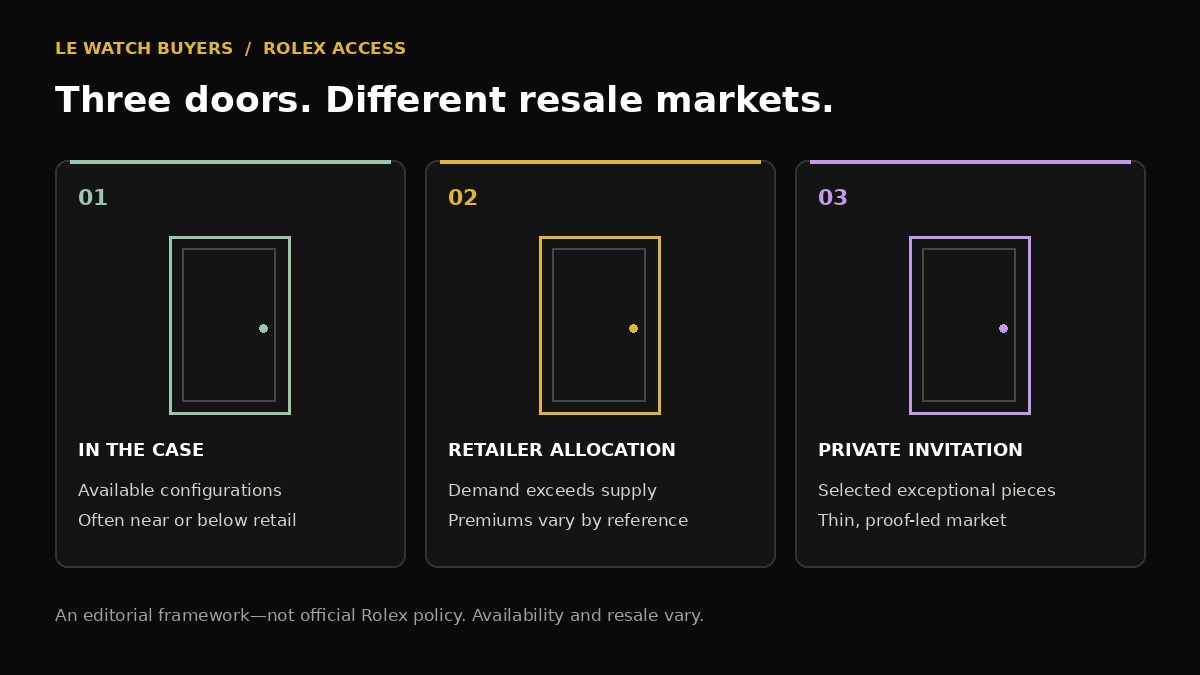
New Rolex watches are normally sold through Official Retailers, which independently manage customer allocation. Some exceptional pieces are offered privately rather than through the public catalog. Limited production, specialist gem-setting, and retailer relationships can all affect access. Retailers may also favor established collectors over buyers they expect to resell immediately. These practices vary by store; Rolex does not publish a universal invitation or spending formula. The twist is that some expensive catalog watches, including precious-metal Day-Dates, trade below retail, while scarce references can command premiums. Price alone does not determine availability or resale value.
The timing of this question is hard to miss. On September 28, 2026, four unique gem-set Cosmograph Daytonas were auctioned individually by Phillips in London, raising £37.3 million for charity. Not one of them passed through a dealer’s display case for ordinary retail sale. Our coverage of The Four Seasons sale covers the watches themselves; this guide covers the system that keeps watches like them out of the showroom in the first place. Phillips has published the final results.
That system has three parts: who actually sells a new Rolex, which watches Rolex chooses to show the public, and what happens to a watch’s value the moment it leaves the store. Understanding all three explains both the frustration buyers feel and the prices sellers get.
The Most Expensive Rolex Is Often the Easiest One to Buy
Start with something that surprises most people. At a well-stocked authorized dealer, some of the most expensive available watches may be solid-gold and platinum Day-Dates, precious-metal Yacht-Masters, and gem-set dress watches. Certain configurations can be available immediately, though display stock is not always for sale and availability varies by store.
Meanwhile, a steel GMT-Master II that retailed for a fraction of the price has been difficult to obtain at list for years — and after Rolex confirmed the discontinuation of its steel “Pepsi” references at Watches and Wonders 2026, the ref. 126710BLRO traded around $22,500 on the secondary market, roughly double its final list price.
The secondary market explains the difference. According to the second-quarter 2026 report from Morgan Stanley and WatchCharts, in-production Rolex models traded an average of 9.8% above retail across the five markets studied as of June 29, 2026, and 14.0% above in the United States. But the Day-Date collection traded an average of 8.3% below retail, and the Yacht-Master 8.6% below.
A high price does not necessarily make a Rolex difficult to buy. Strong demand relative to supply creates allocation pressure — and at the very top are exceptional watches without a public price listing.
So the honest version of the question is not “why won’t Rolex sell me its most expensive watch?” It is “why won’t Rolex sell me the watches that are worth more than they cost?” Those are two very different categories, and they sit behind different doors.
The Three-Door Rolex Access Model
We group ordinary new-watch purchases into three broad access routes. This is our editorial framework, not a Rolex policy or a valuation formula. Which door a watch comes through can help explain how hard it is to buy and how it behaves on the resale market. Reference, condition, originality, and current demand still determine an individual valuation. Special charity auctions, such as The Four Seasons sale, sit outside these usual retail routes.
In the Case
Some precious-metal Day-Dates, Yacht-Masters on Oysterflex, two-tone Datejusts, and gem-set dress pieces. Particular configurations may be available without a long wait.
Retail pricing reflects materials, positioning, and periodic price increases.
Resale: can sit at or below retail. Metal content contributes value but does not guarantee an offer.
The Waitlist
Scarce steel sports references — Daytona, GMT-Master II, Submariner — and any remaining retailer stock of newly discontinued models.
Allocation depends on supply and the retailer’s own client-selection practices.
Resale: may exceed retail, sometimes substantially. Premiums change.
By Invitation
Selected off-catalog, gem-set, hardstone-dial, and exceptional pieces. Some are shared privately with select clients rather than through a public configurator.
Access is relationship-dependent, with no published universal application process.
Resale: thin market, potentially substantial premiums, with documentation essential.
“Most expensive” often lives in Door 3. In 2026, the off-catalog releases shown to clients after Watches and Wonders were reported to include a GMT-Master II in Everose gold with a chrysocolla stone dial, ref. M126755EMSA-0003, at approximately $379,000, and a white-gold GMT-Master II with a blue quartz dial, ref. M126759SABL-0001, at approximately $253,000. These are reported trade prices, not public Rolex price quotations.
Door 3 also became a little less invisible this year. Rolex added an “Exceptional Watches” section to its New Watches 2026 page, featuring the grand feu enamel Cosmograph Daytona ref. 126502 and a Day-Date 40 in its new Jubilee gold alloy. Showing a watch publicly is not the same as making it readily available. Rolex has let more people see through the glass, while retailers remain the point of contact for availability.
Why Rolex Holds Back — Six Reasons That Go Beyond Resale
1. Rolex doesn’t sell to you. Its retailers do.
For ordinary new-watch purchases, Official Retailers buy watches from Rolex and resell them to the public. A historical Rolex dealer agreement dated April 3, 2000, filed publicly with the SEC, describes that arrangement, including Rolex’s discretion over stock supplied to each location. Rolex’s current terms separately confirm that retailers independently manage allocation and sales. That is why two dealers in the same city can give you completely different answers about the same watch — and why “Rolex won’t sell me one” is often, precisely, “this retailer hasn’t allocated one to me.” Rolex deepened its role in retail when it agreed to acquire Bucherer, one of its largest retail partners, in 2023.
2. Some watches cannot be made in volume.
A gradient sapphire bezel requires dozens of stones cut, color-sorted, and matched so the transition reads as seamless. A hardstone dial varies slab to slab, and suitable material must meet demanding quality requirements. Specialist setting involves both skilled people and suitable stones. Rolex does not publish annual production totals or reference-level quantities. Its own explanation is that hand assembly and quality standards restrict capacity, and demand for certain models can exceed it. There are not necessarily enough exceptional watches to sell to everyone who can afford one.
3. Every flip transfers value away from the brand.
When a watch is worth more on the secondary market than at the counter, the first buyer may capture that gap by reselling it. Premiums vary substantially by reference and date. Selling a coveted watch to someone who lists it the following week can hand a speculator the benefit of scarcity. Retailers are widely reported to consider purchase history and whether clients keep what they buy. That helps explain why some exceptional pieces are offered to established clients, though it is not a published Rolex-wide allocation formula.
4. Rolex manages where its most exceptional watches are seen.
A watch with a rainbow bezel or a stone dial is a statement about the brand, not just the wearer. In our interpretation, selective placement can support that positioning and strengthen relationships with established collectors. Keeping some watches outside the public catalog also makes them less visible to routine comparison shopping. Rolex has not published a rule specifying which wrists, rooms, or photographs determine allocation.
5. The wait is part of the product.
Some coveted Rolex watches have traded above their retail prices for years. A retail price below the secondary-market level creates excess demand and a queue. In our view, the gap between list price and market price contributes to the brand’s desirability. That is an interpretation of the market, rather than evidence that Rolex formally sets waiting times to protect resale premiums.
6. It rewards relationships over transactions.
Collectors who receive off-catalog offers often describe steady buying over many years, genuine interest, and not flipping. Spending can matter, but there is no published threshold or guarantee. A client who has kept watches for a decade may look like a reliable long-term collector to a retailer deciding where to place scarce stock. Each store manages its own relationships.
“People think the list is about money. It’s about predictability. A retailer holding a watch the street would pay twice retail for is looking for one thing — the client least likely to put it back on the street. Spend opens the conversation. History closes it.”
Xenon · Watch Appraiser & Expert, Le Watch BuyersWhich Door Did Your Rolex Come Through?
It can help explain your watch’s market position. Send us a few photos and the reference number — we usually respond with an offer the same day.
Get My Free Expert Appraisal →What Rolex’s Allocation System Does to Resale Value
Allocation helps explain the Rolex secondary market. Watches with strong demand relative to supply can trade above retail. Models that are easier to obtain new may trade at or below list. The price tag alone tells you surprisingly little, and access is only one part of a valuation.
| Door | Typical Resale vs. Retail | Value Considerations | Liquidity |
|---|---|---|---|
| 1 · In the Case | Below to near list Day-Date −8.3%, Yacht-Master −8.6% | Reference, condition, demand, gold and platinum content | Established market; varies by configuration |
| 2 · The Waitlist | Often above list For context: all in-production Rolex U.S. average +14.0% | Demand relative to supply; discontinuation can change prices | Often strong for popular references |
| 3 · By Invitation | Potentially above private list | Factory-verified gem-setting, dial originality, provenance | Thin — fewer buyers, wider price ranges |
Three things in that table matter to anyone thinking about value.
Door 1 watches have material value, but no guaranteed resale floor. A gold Day-Date can trade below its sticker price for years. Its recoverable metal contributes value, but net proceeds depend on actual precious-metal weight, purity, costs, and the buyer’s offer. Retail increases can also widen the gap between new and pre-owned pricing. Reuters reported an average 5% increase for Rolex gold watches in June 2026, following increases earlier in the year. Our 2026 list of Rolex models below retail breaks this down reference by reference.
Door 2 premiums are real but not permanent. Steel sports premiums corrected sharply from their 2022 peaks. A discontinued reference no longer receives ongoing factory supply, but that does not guarantee a price increase: demand, existing inventory, and speculation still matter. WatchCharts reported that the 126710BLRO fell during Q2 2026 despite the attention surrounding its discontinuation.
Door 3 value depends on proof, not rarity alone. Off-catalog pieces can command far more than their private list prices, and a genuinely unique factory gem-set Daytona sold at auction for more than CHF 5.5 million in 2024. But the market is thin, results vary widely, and a crucial question is: did this watch leave Rolex exactly as it is now? Unique charity-auction results are not direct comparables for ordinary private sales.
Because off-catalog watches are hard to buy and easy to admire, aftermarket jewelers build look-alikes by adding stones and stone dials to standard production watches. Some are sold honestly as custom pieces. Others drift into the market described as factory originals. The difference in value is not simply a discount — it is a different category of watch, and an aftermarket-set piece can sell for meaningfully less than the same reference left untouched.
If you own what you believe is an off-catalog Rolex, the paperwork, the reference suffix, and the setting itself all need to agree. Seek a specialist evaluation before authorizing polishing, re-setting, or replacement of original parts.
“Price is the worst predictor of Rolex resale I know. A $60,000 gold Day-Date and a $12,000 steel GMT can end up worth almost the same on the day you sell. What predicts value is how hard the watch was to get new — and, at the very top, whether you can prove it came from Rolex exactly as it sits in front of me.”
Xenon · Watch Appraiser & Expert, Le Watch BuyersIf You Already Own One of These Watches
Allocation shapes the decision to sell as much as the price you will get. A few practical points from the other side of the counter:
- Know your door before you price your watch. A Door 1 watch is valued on reference, condition, completeness, demand, and material content. A Door 2 watch is valued against its current secondary market. A Door 3 watch needs especially careful authentication and provenance checks before comparisons are meaningful.
- Keep every piece of paper. Warranty card, box, booklets, hang tags, service records, and the original receipt. For off-catalog pieces, documentation is often the difference between a factory premium and an open question.
- Weigh the relationship honestly. If you bought the watch recently through a retailer that allocated it to you, selling it may affect what that retailer offers you next. That is a real cost for some collectors and irrelevant to others. It is your decision to make with your eyes open, not a reason to hold a watch you no longer want.
- Don’t improve it without advice. Polishing, replacement parts, and added stones can reduce collector value, particularly on rare watches. Necessary servicing is a separate question: discuss it with a specialist and retain records of all work.
We buy Rolex watches outright, from Door 1 gold Day-Dates to Door 3 gem-set pieces, anywhere in the 50 states, with in-person appointments in the New York metro by arrangement. Shipping is prepaid, tracked, and insured by FedEx overnight. Payment is by bank wire, sent once the watch has been inspected and authenticated and you have accepted the final offer.
Why Rolex Won’t Sell You Its Most Expensive Watches: FAQ
Why won’t Rolex sell me the watch I want?
What is an off-catalog Rolex?
What is the most expensive Rolex you can buy?
How do you get offered off-catalog Rolex watches?
Do expensive Rolex watches hold their value?
Will selling my Rolex affect my ability to buy another one?
Does Rolex sell directly to customers?
Why do some Rolex watches sell below retail?
Door 1, 2, or 3 — Know What Your Rolex Is Worth
Our appraisers read the whole watch — reference, dial, setting, and paperwork — and make a serious, documented offer. We usually respond with an offer the same day.
Get My Free Appraisal →Free appraisal · No obligation · All 50 states · (917) 728-7999
Related reading: How to Sell Your Rolex · Watch Education hub
Sources: Morgan Stanley and WatchCharts, second-quarter 2026 Swiss watch secondary-market note (prices as of June 29, 2026), with WatchPro’s report coverage; WatchCharts Rolex price data; Official Rolex Jeweler Agreement dated April 3, 2000, public SEC filing; Rolex, terms of use; 2026 off-catalog price coverage; Reuters on June gold-watch price increases; Phillips, The Four Seasons auction results.
Le Watch Buyers · New York · lewatchbuyers.com · Le Watch Buyers is an independent watch buying service with no affiliation with Rolex SA, its Official Retailers, or Phillips. “Rolex,” “Oyster Perpetual,” “Day-Date,” “GMT-Master II,” “Cosmograph Daytona,” “Yacht-Master,” “Everose,” and related terms are trademarks of Rolex SA. “Off-catalog” is a collector term, not a Rolex designation. Off-catalog prices are as reported in trade coverage and are not published by Rolex. Descriptions of retailer allocation practices reflect reported industry behavior and vary by store. The Three-Door model and interpretations of brand strategy are Le Watch Buyers’ analysis, not official Rolex policies. Market snapshots retain their stated dates and are subject to change. This is independent editorial content and does not constitute financial or investment advice; individual watches must be evaluated in person.